
This shift does not replace search optimization. It expands it. Traditional SEO builds discoverability, while Generative Engine Optimization (GEO) ensures your brand is referenced, trusted, and cited when AI generates answers.
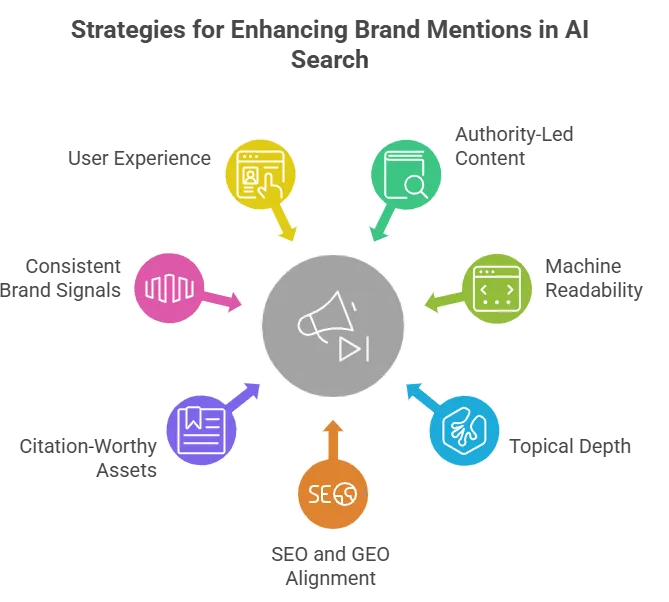
Here are seven strategic ways to strengthen your brand mentions and citations across AI-driven search environments.
Table of Contents
1. Build Authority-Led Content, Not Just Keyword-Led Content
What works better is:
- Insight-led articles that explain industry challenges and solutions
- Educational resources that demonstrate subject-matter expertise
- Data-backed perspectives that help decision-makers evaluate options
- Clear explanations of processes, technologies, or methodologies
2. Structure Content for Machine Readability
AI systems interpret information differently from traditional crawlers. They rely heavily on clarity, structure, and contextual relationships between topics.
To improve citation potential:
- Use clear headings that reflect real user questions
- Include concise summaries before deep explanations
- Break down complex topics into logical sections
- Use lists, tables, and definitions to simplify interpretation
3. Strengthen Topical Depth Instead of Publishing High Volumes
Publishing large volumes of surface-level content does not improve AI visibility. Authority comes from depth, not frequency.
- A pillar page explaining a core solution
- Supporting content addressing use cases, implementation, and outcomes
- FAQs answering real buyer concerns
- Case studies demonstrating applied expertise
4. Align SEO and GEO Instead of Treating Them Separately
GEO builds on this by ensuring that what is discovered is authoritative enough to be referenced.
An integrated approach includes:
- Optimized site architecture that supports both indexing and contextual understanding
- Content designed for both search visibility and answer relevance
- Metadata and schema that clarify meaning, not just keywords
- Pages that address intent, not just traffic generation
When SEO creates access and GEO builds trust, brands gain both rankings and AI citations.
5. Develop Citation-Worthy Assets
AI platforms tend to reference materials that resemble research or knowledge resources rather than promotional pages.
High-performing formats include:
- Industry guides that explain evolving trends
- Technical explainers that clarify complex solutions
- Original insights derived from implementation experience
- Long-form educational resources addressing evaluation criteria
6. Maintain Consistent Brand Signals Across Digital Touchpoints
AI models interpret brand authority through consistency. Disconnected messaging across platforms weakens recognition.
To strengthen entity-level trust:
- Ensure messaging aligns across website pages, articles, and profiles
- Maintain clarity around services, expertise areas, and industries served
- Reinforce positioning through thought leadership rather than promotional claims
- Build a coherent narrative about what your organization solves and for whom
Consistency allows AI systems to confidently associate your brand with specific domains of expertise.
7. Design User Experience That Supports Information Confidence
Experience-led design is becoming a credibility factor. AI increasingly evaluates how well users can navigate, understand, and validate information.
Websites that encourage citations typically:
- Present information clearly without friction
- Offer logical pathways between related topics
- Provide contextual validation such as case examples or process explanations
- Load quickly and function seamlessly across devices
When users trust the experience, AI models interpret those signals as indicators of reliability.
Why This Matters for High-Intent Buyers
In B2B environments, buyers conduct deeper independent research before engaging with vendors. AI-assisted discovery accelerates this process by filtering information and presenting trusted sources upfront.
If your brand is not part of those synthesized answers:
- You may never enter the consideration set
- Competitors with stronger authority signals may shape the narrative
- Decision-makers may rely on AI-generated recommendations before visiting your site
Improving mentions and citations ensures your expertise is visible during the earliest stages of evaluation, where influence is highest.
The Shift from Visibility to Validation
Traditional digital strategies focused on being found. AI-driven discovery focuses on being validated.
That validation comes from three factors:
- Demonstrated expertise through meaningful content
- Structured knowledge that machines can interpret
- Consistent authority signals across the digital ecosystem
Businesses that adapt to this model position themselves not just as searchable, but as trustworthy sources of insight.
Integrating This Approach Into a Modern Digital Strategy
Organizations seeing the strongest results are not replacing their existing marketing frameworks. They are evolving them.
A unified model brings together:
- Search optimization that ensures discoverability
- Content ecosystems that demonstrate expertise
- GEO strategies that influence AI-generated recommendations
- Experience design that builds confidence in information
- Performance insights that refine visibility across both search and AI environments
This convergence allows brands to move from competing for clicks to shaping conversations.
The Competitive Advantage of Acting Early
AI-led discovery is still developing. That creates a window of opportunity.
Brands investing now can:
- Establish authority before their markets become saturated
- Influence how AI systems associate expertise within their industries
- Build durable visibility that compounds over time
- Reduce long-term dependence on paid acquisition channels
Those who delay may find themselves trying to displace competitors who have already become the referenced sources.
Conclusion
FAQs
1. What is the difference between SEO and Generative Engine Optimization?
SEO focuses on improving visibility in search engine results pages, while Generative Engine Optimization ensures your brand is referenced in AI-generated answers. Together, they help businesses get discovered and trusted across both search and AI platforms.
2. Why are AI platforms important for B2B decision-making?
Many decision-makers now begin research using AI tools to get summarized insights, comparisons, and recommendations. If your brand appears in those answers, you influence buyers earlier in their evaluation journey.
3. How can my business increase the chances of being cited by AI tools?
Creating authoritative, well-structured, and insight-driven content improves citation likelihood. AI platforms prioritize expertise, clarity, and credibility over promotional messaging.
4. Do I still need SEO if AI search is growing?
Yes. SEO remains the foundation for discoverability. GEO builds on SEO by ensuring that the content being discovered is authoritative enough to be referenced by AI systems.
5. What type of content performs best in AI-driven search environments?
Educational guides, industry insights, technical explainers, and problem-solving resources perform better than purely sales-driven pages because they provide contextual value AI systems can reference.
6. How long does it take to see results from a GEO strategy?
GEO is a cumulative process. As authority signals strengthen and content ecosystems expand, brands typically see gradual improvements in mentions, citations, and qualified traffic over time.
7. Can GEO help generate higher-quality leads compared to traditional traffic?
Yes. Traffic influenced by AI recommendations often comes from users already researching solutions, making them more informed and closer to decision-making stages.
8. Is GEO only relevant for technology companies?
How useful was this post?
Click on a star to rate it!
Average rating 4.6 / 5. Vote count: 9
No votes so far! Be the first to rate this post.