

Table of Contents
A few years ago, digital discovery was relatively simple. A customer typed a query into a search engine, browsed a few results, visited a website, and made a decision.
Today, that journey looks very different
Customers search across multiple platforms before they trust a brand. They may begin with a search engine, continue their research on social media, watch videos, read case studies, and even ask questions to AI chatbots before reaching out to a company.
A manufacturing buyer might ask an AI assistant for the best industrial suppliers.
A patient might search online for healthcare providers and watch doctor videos explaining treatments.
A student might explore universities through YouTube campus tours and Instagram posts.
A SaaS buyer might read expert blogs, compare tools on review sites, and watch product demos.
In every case, the same question determines success:
Is your brand visible wherever your customers are searching?
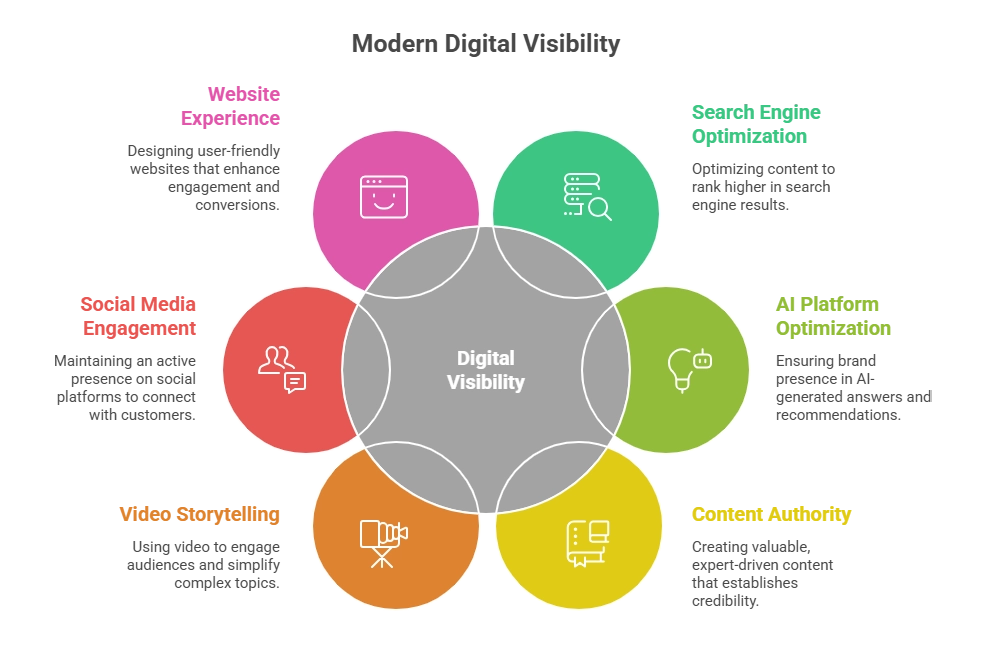
Modern digital visibility is no longer about ranking in one place. It is about building presence across search engines, AI platforms, social media, videos, and authoritative content channels.
Businesses that understand this shift are building stronger authority, deeper trust, and better customer engagement.
Today’s digital discovery process is multi-layered.
Before choosing a brand, customers interact with several information sources. A typical journey may look like this:
This means brands must build visibility across multiple digital ecosystems rather than focusing on a single channel.
Companies that appear consistently across these platforms gain a clear advantage. They become familiar, credible, and trustworthy.
Search engine optimization remains a core part of digital marketing. However, the way search engines deliver information is evolving.
Search engines increasingly use AI to generate answers directly within results pages. These answers summarize information from multiple sources and highlight brands that demonstrate authority and credibility.
At the same time, AI platforms such as ChatGPT, Perplexity, and Gemini are becoming discovery tools. Users now ask these platforms for recommendations, research insights, and solution comparisons.
This evolution does not replace SEO. Instead, it expands the scope of digital visibility.
Modern strategies combine:
Together, these elements help brands appear across the full spectrum of digital discovery.
When customers encounter a brand repeatedly across different platforms, it builds trust.
For example:
This consistency signals authority.
It also improves the quality of traffic. Users who discover brands through multiple trusted sources are often closer to making a decision.
Multi-platform visibility also creates long-term advantages:
Healthcare discovery is increasingly digital.
Patients search for symptoms, treatments, hospitals, and specialists online. They also rely on educational videos and expert content to understand medical conditions.
Healthcare organizations must focus on:
Trust and clarity are critical in healthcare. Brands that provide helpful, accurate information gain stronger credibility.
Students and parents now evaluate institutions online before making decisions.
Discovery often includes:
Educational institutions that combine search visibility, video storytelling, and social engagement create stronger connections with prospective students.
Manufacturing buyers often conduct extensive research before contacting suppliers.
They evaluate:
Manufacturing companies can improve visibility by publishing:
This type of information helps buyers understand capabilities and builds trust before initial conversations.
SaaS buyers rely heavily on digital research.
They compare software tools, evaluate features, and review expert opinions before committing to a solution.
Discovery channels often include:
SaaS companies that combine educational content, product demonstrations, and expert insights often gain stronger credibility.
Retail discovery increasingly happens across visual platforms.
Customers explore products through:
For retail brands, strong digital presence includes:
Visual storytelling plays a major role in building interest and trust.
Video has become one of the most powerful discovery channels.
Customers use video to:
Videos also help brands communicate more effectively than text alone.
Examples include:
For industries such as healthcare, manufacturing, and education, video content helps simplify complex topics and build credibility.
Social media platforms are no longer just engagement channels. They are discovery platforms.
Many users now search directly within platforms such as:
Social media content helps brands remain visible in everyday digital conversations.
Consistent posting, industry insights, and engaging content strengthen brand authority and drive traffic to core digital assets such as websites and blogs.
Businesses that want to remain competitive must focus on long-term digital authority.
Key strategies include:
Content should address real questions and provide meaningful insights.
Mentions, citations, and trusted references help search engines and AI platforms recognize credibility.
Videos improve engagement and simplify complex topics.
Social platforms help brands remain visible in industry discussions.
Clear navigation, fast performance, and user-focused design improve engagement and conversions.
Search engines and AI platforms are both shaping modern discovery.
Digital discovery is expanding far beyond traditional search engines.
Customers now explore brands through search results, AI-generated answers, videos, social media platforms, and industry conversations. Every interaction contributes to how they evaluate credibility and trust.
Organizations that build visibility across these touchpoints create stronger brand recognition and deeper customer relationships.
Success today depends on more than rankings. It depends on being present wherever your customers search, learn, compare, and decide.
Brands that embrace this broader digital ecosystem will not only stay visible. They will become trusted authorities in their industries.
Those who adapt now will lead to the next era of digital discovery.
Pixel Studios helps organizations build integrated digital visibility strategies that combine SEO, Generative Engine Optimization (GEO), experience-driven design, and content authority to ensure brands are discovered across the modern search ecosystem.
Customers no longer rely on a single search engine to discover brands. They use search engines, AI chatbots, social media platforms, and video channels during their research process. Being visible across these channels ensures your brand appears at every stage of the buyer journey, increasing credibility and improving the chances of engagement and conversions.
Search engines help users find information through ranked results, while AI platforms provide direct answers based on trusted sources across the web. Together, they shape how customers research products and services. Businesses that optimize content for both environments improve their chances of appearing in search results as well as AI-generated answers.
High-quality, informative content helps search engines and AI platforms understand your brand’s expertise. Blogs, guides, case studies, and educational resources answer common customer questions and establish authority. When content addresses real user intent, it becomes more likely to be referenced, shared, and recommended across digital channels.
Video content allows businesses to demonstrate products, explain complex solutions, and build stronger engagement with audiences. Platforms like YouTube and social media channels are increasingly used for research and product discovery. Videos that provide educational or demonstration-based insights often appear in search results and help build brand trust.
A well-designed website ensures visitors can easily find the information they need. Clear navigation, fast loading pages, mobile responsiveness, and structured content improve both user experience and search visibility. When users spend more time exploring a website, it signals relevance and authority to search engines.
Businesses can improve their presence in AI-driven search environments by publishing credible content, maintaining consistent brand information across platforms, and building authoritative backlinks. Structured data, well-organized content, and industry expertise also help AI systems identify reliable sources to reference in their responses.
Organizations should evaluate where their target audience searches for information and ensure consistent visibility across those channels. This includes optimizing websites for search engines, creating authoritative content, leveraging video platforms, maintaining active social media presence, and ensuring content is structured for emerging AI-powered discovery systems.
How useful was this post?
Click on a star to rate it!
Average rating 4.6 / 5. Vote count: 10
No votes so far! Be the first to rate this post.