
Search behaviour is changing as customers increasingly use AI-powered platforms to find businesses, compare services, and research products. Traditional search engines such as Google and Bing display a list of relevant websites, while AI platforms such as ChatGPT, Gemini, and Perplexity provide direct answers based on information gathered from different sources.
This shift has made two digital marketing strategies important: Search Engine Optimisation (SEO) and Generative Engine Optimisation (GEO). Although both aim to improve online visibility, they follow different approaches. Understanding these differences can help businesses reach potential customers through traditional search results and AI-generated responses.
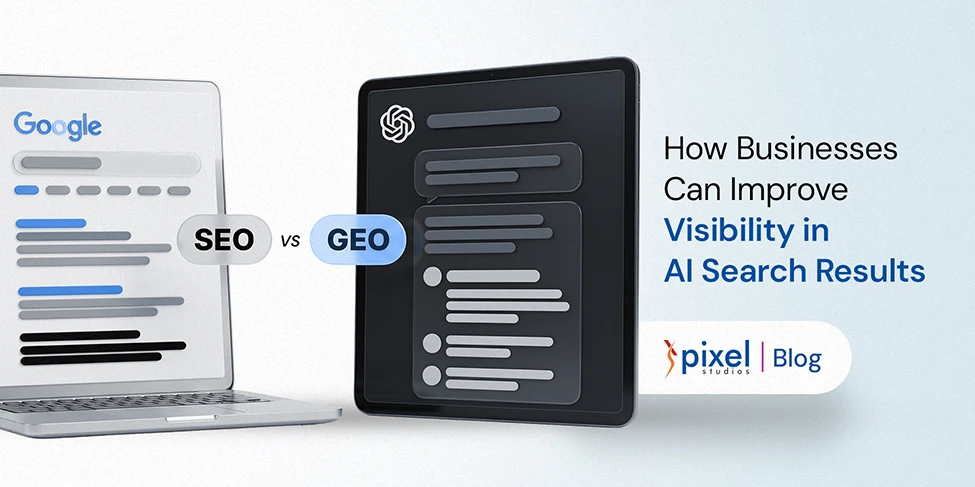
SEO focuses on improving website rankings in search engine results pages (SERPs). GEO focuses on improving a brand’s chances of being mentioned or cited in AI-generated answers.
For example, when someone searches for “best digital marketing agency in Chennai”, SEO helps an agency appear in Google’s organic search results. When someone asks ChatGPT to recommend digital marketing agencies in Chennai, GEO focuses on improving the business’s visibility in the generated response.
Here are the major differences between the two strategies:
| Comparison factors | SEO | GEO |
|---|---|---|
| Main objective | Improve organic search rankings | Improve visibility in AI-generated answers |
| Platforms | Google, Bing | ChatGPT, Gemini, Perplexity, Copilot |
| Content approach | Keyword and search-intent focused | Contextual, informative and answer-focused |
| Visibility | Organic listings and search features | AI mentions, recommendations and citations |
| Authority signals | Backlinks, content quality and relevance | Brand mentions, source credibility and relevant information |
| Keyword strategy | Target keywords and search queries | Natural-language questions and conversational prompts |
| Performance metrics | Rankings, clicks and organic traffic | AI visibility, mentions, citations and referral traffic |
SEO and GEO are not competing strategies. They address different ways customers discover information online.
Customers traditionally visited multiple websites to compare products and services. Today, AI-powered platforms allow users to ask detailed questions and receive summarised answers.
Consider someone looking for a website development company.
Through traditional search, the user searches on Google, reviews different websites, compares services, and contacts a suitable agency.
Through AI-powered search, the user may ask ChatGPT, “Which website development companies in Chennai offer custom business websites?” The platform generates recommendations based on available information and may provide supporting website references.
This creates additional opportunities for businesses to reach potential customers. Companies need to consider both traditional search rankings and their presence in AI-generated responses.
SEO and GEO share some common foundations, including relevant content, website quality, and online authority. However, their optimisation priorities differ.
SEO optimisation focuses on:
GEO optimisation focuses on:
For example, a healthcare technology company should maintain accurate product information, company details, industry expertise, and relevant third-party references. This helps search systems understand the business and its offerings.
However, no individual optimisation activity guarantees that an AI platform will mention or cite a particular business.
Another important difference between SEO and GEO is performance measurement.
Traditional SEO provides established metrics through tools such as Google Search Console and Google Analytics. GEO requires additional monitoring because businesses may appear in AI-generated answers without receiving direct website traffic.
| SEO metrics | GEO metrics |
|---|---|
| Organic traffic | AI Visibility Score |
| Keyword rankings | AI search presence |
| Search impressions | Brand mentions and citations |
| Organic clicks | AI referral traffic |
| Click-through rate | High-intent prompt visibility |
| Backlink growth | Third-party cited domains |
| Website conversions | AI-assisted conversions |
Businesses can use SEO tools alongside GEO monitoring platforms to understand their performance across Google, ChatGPT, Gemini, Perplexity, and other AI-powered search experiences.
Monitoring competitor visibility can also help identify content gaps and new opportunities.
Focusing only on traditional SEO may limit opportunities to reach customers who increasingly use AI platforms for research and recommendations. Similarly, focusing only on GEO without maintaining a technically healthy website and useful content can create gaps in overall online visibility.
Combining both strategies helps businesses:
For example, a digital marketing agency can use SEO to target keywords such as “SEO services in Chennai” while using GEO to improve its chances of appearing in AI responses to questions about SEO and digital marketing service providers.
Businesses should integrate SEO and GEO into their existing digital marketing activities rather than treating them as completely separate processes.
Start by improving website content, technical SEO, and keyword targeting. Develop informative articles, service pages, and FAQs that address actual customer questions.
Next, strengthen brand presence through relevant industry publications, business directories, customer reviews, and third-party references. Implement appropriate schema markup and maintain consistent company information across online platforms.
Finally, monitor organic search performance and AI visibility regularly. Review brand mentions, citations, cited pages, competitor presence, and AI referral traffic to identify areas that require improvement.
SEO and GEO are becoming important parts of modern digital marketing. While SEO helps businesses improve their positions in traditional search results, GEO creates additional opportunities to gain visibility in AI-generated answers.
Businesses should not choose one strategy over the other. Combining technical SEO, quality content, relevant backlinks, brand authority, and AI-focused optimisation can help build a stronger online presence.
At Pixel Studios, we help businesses improve their digital visibility through SEO, GEO, technical optimisation, content marketing, and AI search strategies. Our approach focuses on helping brands adapt to changing search behaviour and connect with potential customers across multiple platforms.
Looking to improve your business visibility in Google and AI-powered search platforms? Contact Pixel Studios to explore the right SEO and GEO strategy for your business.
How useful was this post?
Click on a star to rate it!
Average rating 4.6 / 5. Vote count: 11
No votes so far! Be the first to rate this post.