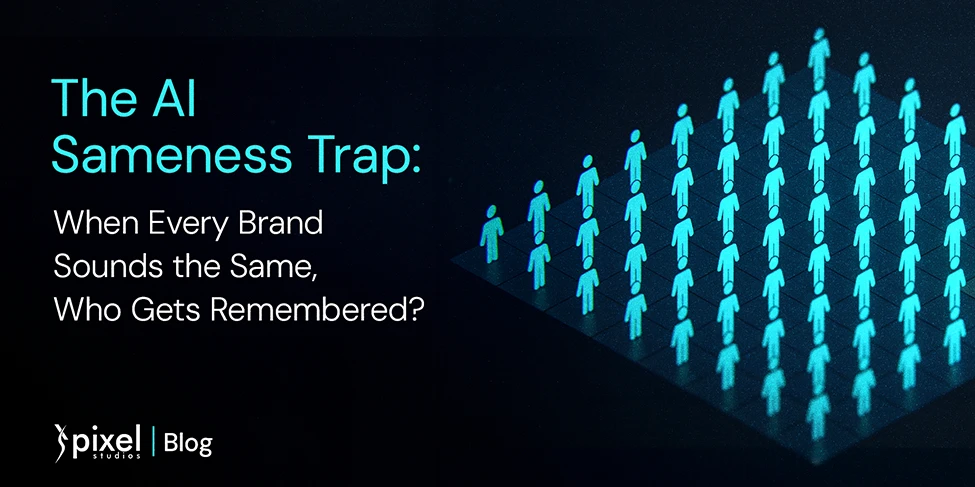

Imagine three competing brands asking AI to create a social media campaign.
Within seconds, all three receive polished headlines, compelling captions and professional-looking visuals.
But there’s a problem.
They all sound remarkably similar.
Phrases like “redefining excellence,” “unlocking possibilities,” and “transforming the future” appear everywhere. The content looks impressive, but the brands behind it become harder to distinguish.
AI has made content creation easier. But has it made brands more memorable?
This is the AI Sameness Trap, and it’s becoming an important challenge for businesses investing in digital marketing.
The AI Sameness Trap occurs when brands rely heavily on generative AI to create marketing content without adding their own perspectives, personality or creative direction.
AI tools learn patterns from existing information. When businesses use similar prompts, they can receive similar messaging, structures and creative approaches.
The result is content that may be technically correct but lacks a distinctive identity.
For businesses, the risk isn’t simply producing repetitive content. It’s losing the qualities that make customers recognise, remember and choose their brand.
AI is exceptionally useful for accelerating research, generating ideas and scaling content production.
However, three common practices can make brands sound alike.
Consider two healthcare brands promoting preventive health screenings.
One publishes a generic message about prioritising wellness. The other shares an empathetic explanation of why people postpone screenings and addresses their concerns.
Both communicate awareness. Only one demonstrates a deeper understanding of its audience.
The difference isn’t the technology. It’s the thinking behind the message.
Customers encounter brands across websites, search engines, social media, advertising and AI-powered discovery platforms.
When multiple businesses communicate identical benefits using similar language, differentiation becomes difficult.
This can create three marketing challenges:
Being visible is important. Being remembered for something meaningful is what helps turn visibility into preference.
The answer isn’t to stop using AI. It’s to combine human creativity with AI intelligence more strategically.
Before creating content, understand your customers’ motivations, challenges and decision-making behaviour.
What questions do they ask? What concerns prevent them from purchasing? What experiences shape their expectations?
Use these insights to guide AI rather than expecting AI to define the entire strategy.
Your brand should communicate with a recognisable personality.
Define its tone, values, perspectives and messaging principles.
A manufacturing company might lead with engineering expertise and reliability, while a lifestyle brand might communicate through emotion and personal experiences.
AI can adapt to these identities when given clear direction and relevant examples.
Every business has something AI cannot independently invent authentically: its actual experiences.
Customer success stories, expert opinions, behind-the-scenes processes and employee perspectives offer opportunities for original storytelling.
Use AI to structure, refine and distribute these stories without replacing their authenticity.
AI can support content research, campaign variations, audience analysis, creative testing and performance optimisation.
Human teams should continue to guide positioning, emotional relevance, factual accuracy and creative decisions.
The strongest approach uses AI to expand possibilities while human expertise determines what deserves attention.
Likes and impressions alone don’t establish whether a brand is becoming more distinctive.
Businesses should also monitor:
Together, these indicators provide a clearer picture of whether marketing is building recognition and business value.
Yes, particularly when it comes to defining what makes a business different.
As AI tools become increasingly accessible, producing polished content will become less of a competitive advantage.
Original thinking, cultural understanding, emotional intelligence and strategic judgement will remain important differentiators.
The opportunity isn’t to choose between human creativity and artificial intelligence.
It’s to combine both to create marketing that is efficient, distinctive and commercially meaningful.
AI sameness occurs when businesses publish similar AI-generated content, messaging or visuals without enough original brand input. This can weaken differentiation and brand recall.
It can when used without clear brand guidelines and human review. AI-generated content should reinforce a brand’s personality rather than replace its unique voice.
Start with customer insights, proprietary knowledge, authentic stories and detailed brand guidelines. Use AI to develop ideas while maintaining human creative direction.
No. AI can improve marketing efficiency and scalability. The priority is using it strategically while retaining human oversight, originality and quality control.
Track branded searches, direct traffic, customer feedback, meaningful engagement and qualified enquiries alongside traditional campaign performance metrics.
Your customers see hundreds of messages every day. Give them a reason to remember yours.
At Pixel Studios, we combine Human Creativity + AI Intelligence to solve marketing challenges, build distinctive brand identities and create measurable business impact.
Let’s make your brand impossible to confuse with the competition.
How useful was this post?
Click on a star to rate it!
Average rating 4.6 / 5. Vote count: 11
No votes so far! Be the first to rate this post.